Loading
Series 2: The Tax Catch — Why Japan’s 1.4% Is Not Australia’s Land Tax?
After hearing that a regional Japanese house may cost around AUD 200,000, many Australian buyers immediately ask:
“What’s the catch? Is the annual tax huge?”
The short answer: usually not in the way Australians expect.
Australia and Japan tax property in very different ways.
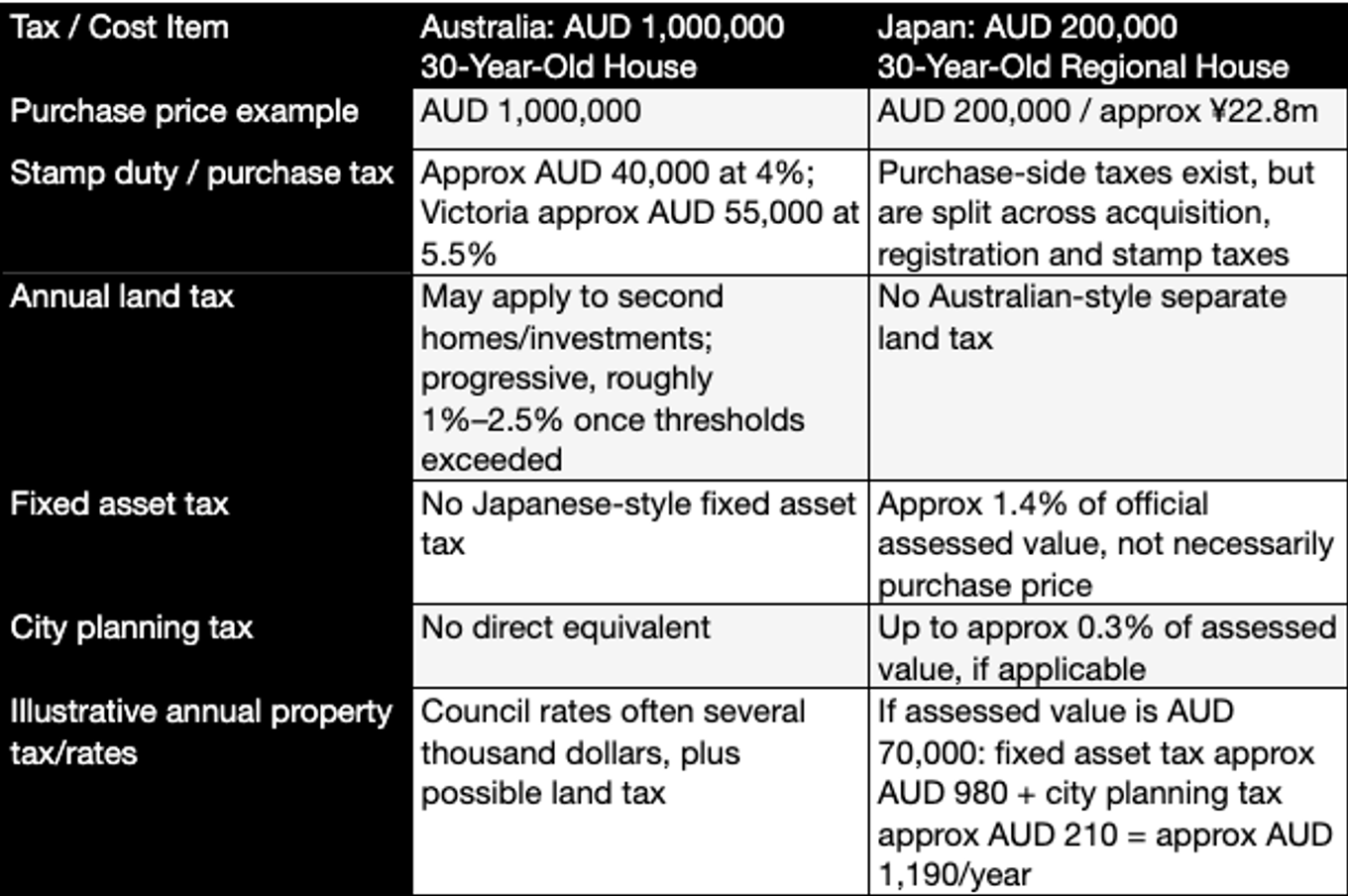
In Australia, the first major shock is usually stamp duty. On a AUD 1 million detached home, a rough working average across states such as Queensland through Western Australia is around 4%, or about AUD 40,000. Victoria is the painful outlier, where stamp duty on a AUD 1 million property can be around 5.5%, or about AUD 55,000.
Then come annual costs: council rates, insurance, maintenance — and, for second homes or investment properties, possible state land tax. Australian land tax is progressive and can range roughly around 1% to 2.5% once thresholds are exceeded. NSW’s 2026 land tax threshold, for example, is AUD 1,075,000, showing how strongly state thresholds affect whether land tax applies at all.
Japan looks similar only if you stop at the percentage.
Japan’s annual fixed asset tax is generally 1.4%, and some areas also charge city planning tax of up to 0.3%. But this is not apples-to-apples with Australian progressive land tax of 1-2.5%. Japan’s tax is generally based on the official assessed value of land and buildings, not simply the purchase price or emotional market value. For older homes, especially around 30 years old or more, the building assessment can be far lower than buyers expect…almost down to zero. Japan also has acquisition-related taxes, but they are split across items such as acquisition tax, registration tax and stamp tax.
Why the difference exists
Australia’s housing market is driven by scarce urban land, strong population growth, and high land values. Even an older house can remain expensive because the land underneath it is valuable.
Japan’s regional housing market works differently. In many towns, the building depreciates heavily over time. A 30-year-old house may be valued less for the structure itself and more for land, renovation quality, location, snow access, convenience and usability.
That is why Japan’s 1.4% fixed asset tax should not be compared directly with Australia’s 1%–2.5% land tax.
They are different taxes, on different bases, in different property markets.
For Australians, the fear is often:
“If the house is cheap, the tax must punish me later.”
But for an older regional Japanese house, the recurring tax bill may be far less frightening than expected because it is usually based on assessed value, not the headline purchase price.
The real catch is not usually a terrifying annual tax bill.
The real catch if any is practical due diligence: building condition, insulation, snow management, repairs, utilities, insurance, local rules, and whether the house genuinely fits the lifestyle you want.
Back to Series 1: Price is only half the story. Size, land and building age explain why Japan can look so cheap — without being too good to be true.